

AI vs Machine Learning vs Data Science: What's the Difference?
Understand how AI, Machine Learning and Data Science differ, with practical examples, common tools, beginner projects, essential skills and career paths.
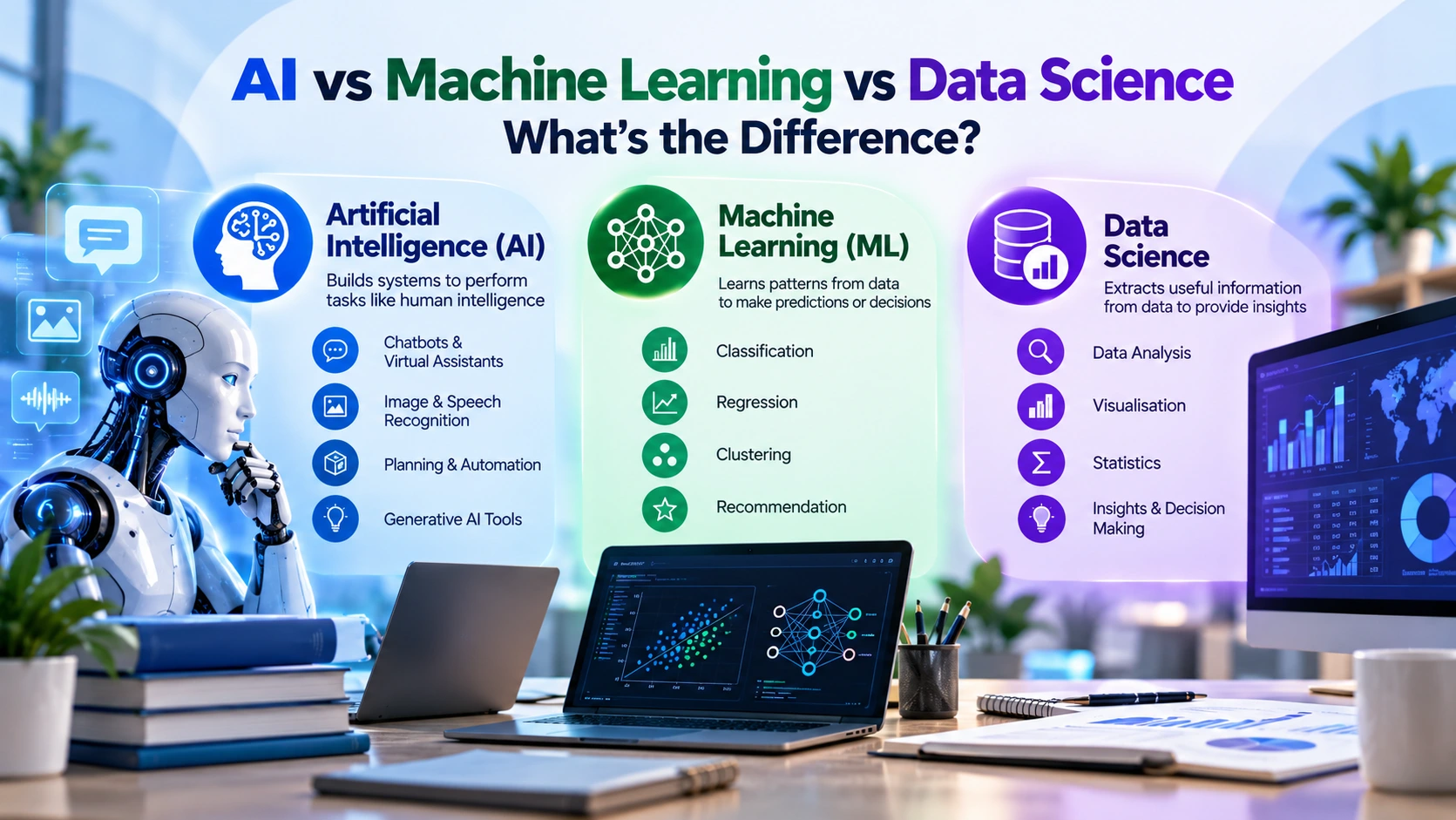
Artificial Intelligence (AI), Machine Learning (ML) and Data Science are very popular areas within technology, however they are not the same thing. This can cause confusion to students and beginners when learning due to overlap in what they do.
In this guide, we will explain the differences between them in easy to understand terms, give examples, show common tools and how to get started.
Understanding Artificial Intelligence, Machine Learning and Data Science
What is Artificial Intelligence?
Artificial Intelligence is a general term used to describe building systems to complete tasks that would typically be associated with human intelligence. This can include understanding language, identifying images, problem solving, planning and creating content.
For example, chat bots can use AI techniques to understand a question and give a response. Image recognition can identify objects in an image. AI can take many forms such as rule-based systems, Machine Learning or Deep Learning.
Common uses of AI include:
- Virtual Assistants / Chat Bots
- Image & Speech Recognition
- Recommendation Systems
- Planning & Automation
- Generative AI tools (tools that create text/images/code)
Artificial Intelligence is the general term. Not all AI systems are based on learning from data, some will use rules. Machine Learning is a key technique used within AI.
What is Machine Learning?
Machine Learning is a subset of AI that enables computers to learn patterns from data. Rather than writing rules for every scenario, developers train their model with examples.
For example, a spam detection model can be trained on messages that are marked as spam or not spam. This can allow the model to give an estimation of whether the message is likely to be spam. The quality of this will depend on factors such as the data, model and evaluation.
Common tasks within Machine Learning include:
- Classification – Predicting a category e.g. Spam / Not Spam
- Regression – Predicting a numerical value e.g. Estimated Sales
- Clustering – Grouping together similar data points
- Recommendation – Identifying products, videos etc that may be relevant to the user.
Popular tools include Python, Scikit Learn, Pandas, NumPy and if applicable Deep Learning tools such as PyTorch or TensorFlow.
A typical workflow for Machine Learning includes preparing data, selecting features, training the model and evaluating it. It is important to evaluate the model with data it has not seen.
What is Data Science?
Data Science involves extracting useful information from data to help answer questions. This can include collecting, cleaning, analysing, statistical analysis and visualisation. It can also include Machine Learning.
For example, if a business wanted to understand why sales have changed over the last 6 months, a Data Scientist or Analyst may combine sales data, clean it, identify trends between products and regions, create visualisations and explain potential reasons. This will help them to understand the information.
Common activities within Data Science include:
- Collecting & Cleaning data
- Exploring data to identify patterns
- Statistical analysis to answer questions
- Creating charts & dashboards
- Creating predictive models
- Communicating findings
Common tools include Python, SQL, Pandas, NumPy, Jupyter Notebooks, Matplotlib and Business Intelligence tools such as Power BI. The tools will depend on the role and task.
Not all Data Science tasks will use Machine Learning. Sometimes careful analysis, good visualisations and reliable reporting can be enough to answer the business question.
Key Differences and a Practical Example
Key Differences Between AI, Machine Learning and Data Science
Each of these areas are related but have a different main goal.
- AI – Building systems to complete tasks associated with intelligence.
- Machine Learning – Using data to train models to recognise patterns, make predictions or decisions.
- Data Science – Using data analysis, statistics and similar techniques to provide insights and help decision making.
A simple way to remember this is that Machine Learning is a subset of AI. Data Science is a more general practice that involves learning from data. Whilst Machine Learning can be used, Data Science can also use statistics, SQL queries, dashboards and other analytical techniques.
Example
An online store wants to improve their customer experience.
- Data Science – The team will analyse the sales data to understand what products are selling well, when there are changes in demand and which customer segments behave differently.
- Machine Learning – The team will train a model to predict future demand or customers who may be interested in the product. They will evaluate how useful the predictions are.
- Artificial Intelligence – The store may use an AI assistant to help answer customer questions or help users find relevant products. This may use Machine Learning or other AI techniques.
In practice there may be some overlap and the team may work together. This shows the different goals.
Choosing a Starting Point and Building Skills
Which should I start with as a beginner?
This will depend on what interests you.
- AI – If you are interested in Intelligent Applications, Chat Bots, Language Technologies, Computer Vision or Automation.
- Machine Learning – If you enjoy coding, working with data and experimenting with models that can make predictions.
- Data Science – If you enjoy finding patterns, using statistics, creating visualisations and explaining what the data means for the business.
You don’t need to decide what you want to do for your whole career straight away. All 3 areas have some useful foundations to learn. Learning Python, basic statistics and data handling will help you to explore different areas.
Skills To Learn As A Beginner
As a beginner, you can start by learning:
- Python – Learn about variables, functions, data structures and writing clean code.
- Data Handling – Practice loading, cleaning and exploring data using Pandas and NumPy.
- Basic Statistics – Understand averages, distributions, variance and how to carefully interpret results.
- Visualisation – Use charts to clearly present patterns.
- Machine Learning – Learn how to use training and testing data. Understand how to evaluate models and common algorithms.
- Problem Solving & Communication – Identify the problem, explain your approach and describe any limitations in your results.
Try learning one concept at a time and applying it to simple examples. You don’t need to be an expert with all the tools to start your first project.
Beginner Projects, Careers and Getting Started
Beginner Projects
Projects will help you to put theory into practice. Ensure you have a clear question and understandable dataset.
- Data Science – Analyse a public sales dataset to create a dashboard showing trends per month and top performing products.
- Machine Learning – Train a basic model to classify messages or predict a numerical value. Evaluate the results from the test data.
- Artificial Intelligence – Create a simple FAQ bot using a small amount of approved questions and answers. Test how it reacts to different phrasing.
Make sure you write down the problem, data source, tools used, process and any limitations. Don’t claim your model is accurate or useful unless you have tested it. A simple project with a good explanation will show what you have learnt.
Careers & Learning Opportunities
All these areas will involve different types of work. The jobs may have different names depending on the organisation.
- AI Developer – Building applications using AI capabilities.
- Machine Learning Engineer – Developing, testing and deploying Machine Learning models.
- Data Analyst – Querying, cleaning and visualising data to answer business questions.
- Data Scientist – Using analysis, statistics and sometimes Machine Learning to investigate problems and gain insights.
The skills required will depend on the role, employer and your experience. The titles may overlap so it is worth looking at actual job descriptions.
If you are a student interested in these areas, there are plenty of learning opportunities. We3vision Private Limited offer training opportunities in AI/ML and related areas. Contact them directly to confirm what is currently available, what you would be eligible for, what the curriculum would be, how long and cost.
Getting Started
A simple plan to get started could be:
- Learn the basics of Python and practice writing simple programs.
- Use a dataset and practice cleaning, exploring and visualising data.
- Learn basic statistics and how to evaluate conclusions.
- Try a simple Machine Learning model and test it with unseen data.
- Create a small project and write down how you have done it. Explain what you have learnt.
- Explore the area you are most interested in and develop further skills.
Focus on understanding the problem and explaining your choices. Tools will change but having clear thinking, careful evaluation and communication will help.
Frequently Asked Questions and Final Thoughts
Frequently Asked Questions
1. What is the main difference between AI and Machine Learning?
AI is a general term that refers to building systems to complete intelligent tasks. Machine Learning is a technique within AI that trains models to learn patterns from data.
2. Is Data Science the same as Machine Learning?
No. Data Science involves extracting insights from data using analysis, statistics and visualisation. It can use Machine Learning where appropriate.
3. Which should I start with as a beginner - AI, ML or Data Science?
Start by learning Python, basic statistics and data handling. Try some simple projects in different areas to see what interests you the most.
4. What programming language is useful for AI, ML and Data Science?
Python is commonly used across all areas. SQL is also useful for working with data.
Final Thoughts
AI, Machine Learning and Data Science are all very related but have different focuses. AI focuses on building systems to complete intelligent tasks, Machine Learning trains models using data and Data Science uses data to extract insights to help with decision making.
Start by learning the common foundations such as Python and data handling. Try some simple projects in each area. This can help you to identify what problems you enjoy solving and what skills you want to develop.
Frequently asked questions
What is the main difference between AI and Machine Learning?
AI is a general term that refers to building systems to complete intelligent tasks. Machine Learning is a technique within AI that trains models to learn patterns from data.
Is Data Science the same as Machine Learning?
No. Data Science involves extracting insights from data using analysis, statistics and visualisation. It can use Machine Learning where appropriate.
Which should I start with as a beginner - AI, ML or Data Science?
Start by learning Python, basic statistics and data handling. Try some simple projects in different areas to see what interests you the most.
What programming language is useful for AI, ML and Data Science?
Python is commonly used across all areas. SQL is also useful for working with data.