

Vehicle Physics in Games: How 3D Cars Drive
How a car drives in a 3D game: a rigid body, wheels with suspension, tyre grip, an engine curve and the choice between arcade and simulation.
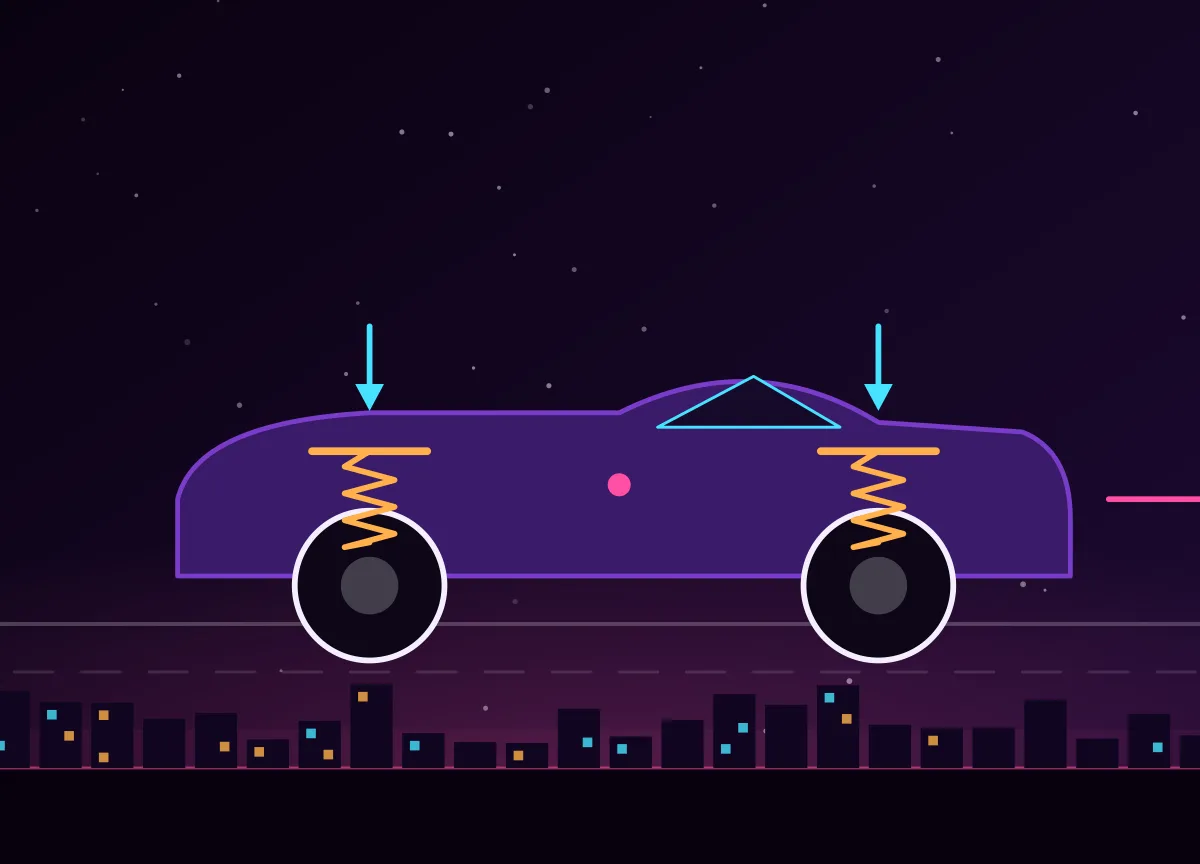
A car in a 3D game is a physics object with a few extra parts. A rigid body gives it mass, four wheels with suspension keep it above the ground, tyre grip decides how it turns, and an engine model pushes it forward. Getting these numbers right is what makes a car feel heavy, light, sporty or slippery. Because players spend a lot of time driving in open-world games, vehicle feel is one of the most tuned parts of the game.
The car as a rigid body
The car body is a rigid body with a mass, a shape for collisions and a centre of mass. A low centre of mass makes the car stable and hard to roll over, which is why many games place it lower than in real life. The physics engine moves the body by applying forces every physics step, usually 50 to 60 times a second.
Wheels and suspension
Each wheel is connected to the body by a spring and a damper. The spring pushes the wheel down to the road, the damper stops it from bouncing forever. In many games the wheel does this by casting a ray towards the ground: the shorter the ray, the more the spring is compressed and the harder it pushes. The basic formula is force = spring strength x compression - damping x speed of compression. Engines include ready-made versions: the WheelCollider in Unity and the Chaos Vehicles system in Unreal Engine.
Tyre grip
Tyres only grip so much. The force a tyre can produce is limited, and it has to be shared between pushing forward and holding the car sideways. This is often called the friction circle. When the driver asks for more than the tyre can give, the tyre slips and the car slides. Simple games use a fixed grip value, advanced ones use a curve of grip against slip so that sliding feels natural.
Engine, gears and steering
- A torque curve says how much force the engine gives at each speed (rpm)
- Gears multiply the torque and change the top speed
- Steering turns the front wheels, often by less at high speed so the car stays easy to control
- Brakes and a handbrake lower the grip of the wheels they act on
- Anti-roll and downforce help the car stay flat in fast corners
Arcade or simulation?
A simulation tries to copy real driving. An arcade model cheats on purpose so that the car is easy and fun: extra grip, stabilising forces, quick turning and forgiving crashes. Open-world action games usually sit near the arcade side, because the player also has to look at the city, follow a mission and fight. Whatever you choose, test it with real players early, because feel is hard to judge from numbers.
Crashes and online cars
Collision damage can be simple (a health value and a different model) or detailed (bendable parts). In online games the server must also agree on where each car is: the car is simulated on the server, and the clients smooth the result. That topic is covered in netcode basics. For the camera behind the car, see third-person camera and controls. The whole picture is in how online open-world games are made.
Frequently asked questions
How do cars work in a 3D game?
A car is a physics rigid body with four wheels. Each wheel has a spring and damper for the suspension and a tyre model for grip, and an engine model with gears pushes the car forward.
What is the difference between arcade and simulation driving?
Simulation driving copies real vehicle behaviour as closely as possible. Arcade driving adds extra grip and stabilising forces so the car is easy and fun to control.
Which engine has built-in vehicle physics?
Unity has the WheelCollider component and Unreal Engine has the Chaos Vehicles system. Both give a starting point, and most games tune or replace parts of them for the feel they want.